Hello! This is Goencha! Today, I'd like to talk about the size of business cards, something we often use without giving it much thought. When you think of business cards, many people probably picture a size of 55 x 91 millimeters. It is said that this size is actually related to Japan's unique history and culture, as well as the proportions that people find aesthetically pleasing.
Learning about the background behind business card sizes and how they differ from those in other countries might make your usual business cards look a little different. This time, we'll share some interesting facts about business card sizes that you'll want to tell everyone about.
We also recommend our seasonal greeting tea! Just put a stamp on it and send it as is!


Table of Contents
Why are business cards this size?
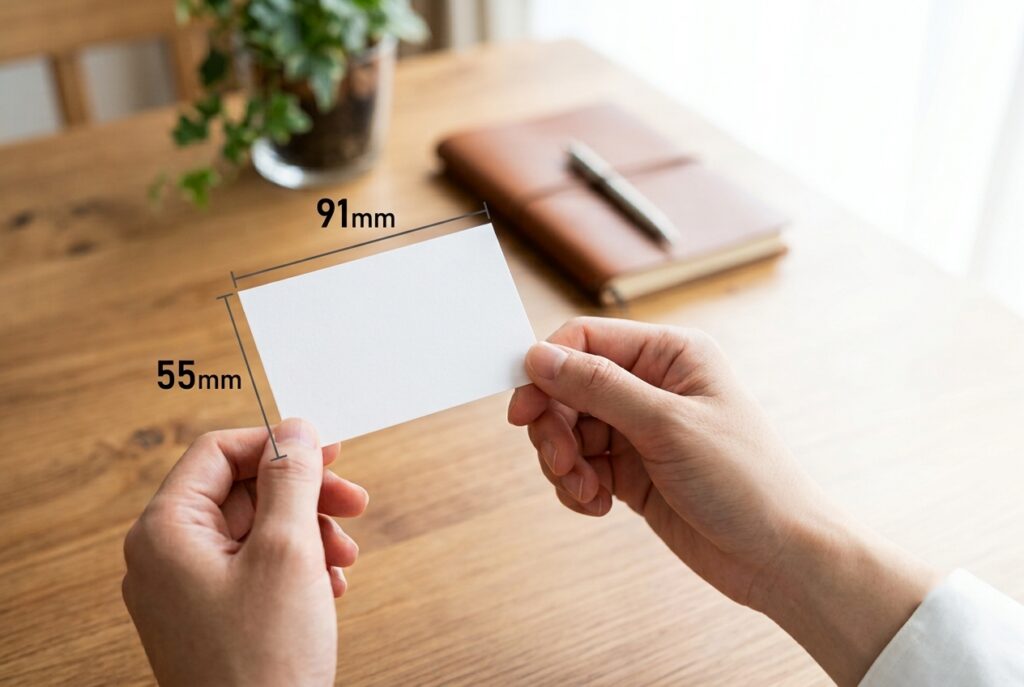
Business cards are handed out in business settings and when introducing new acquaintances. While we use them routinely, most business cards are roughly the same size. Why is this size so common for Japanese business cards? There are hidden reasons behind this, including a long-standing cultural tradition and thoughtful design choices for ease of use. Let's begin by looking at the basic size of the business cards we commonly use.
The standard size for a business card is 55 x 91 mm.
The business cards commonly seen in Japan are 91 mm wide and 55 mm tall, a size known as "size 4." In fact, most of the business cards we use every day are made to this size. Business card holders and card cases are also often made to fit this size.
However, there isn't just one size for business cards. In fact, there are several types, including slightly more compact ones and larger ones that leave a stronger impression. Since the impression given changes depending on the size, some people carefully choose the size when designing their business cards.
We've created a table summarizing the characteristics of each size and the situations in which they are most commonly used. Please compare them and enjoy finding the perfect business card image for you.
| Types of sizes | Dimensions (millimeters) | Main features and uses |
|---|---|---|
| No. 3 (female business card) | 49×85 | It's slightly smaller and popular for things like shop cards. |
| Size 4 (standard business card) | 55×91 | It is most widely used in business settings. |
| No. 5 | 61×100 | It is used for cards that you want to stand out, or for invitations. |
Also recommended to include with your business card! For tea gifts, try “Kyoto Gyokuro’s Goen Tea”.
What is Kyoto Gyokuro’s Goen Tea?
" Kyoto Gyokuro no Goencha " is a tea shop that delivers tea from Kyoto with the concept of "making tea more enjoyable." We strive to make high-quality tea more accessible and familiar to people, tailoring our offerings to meet their needs.
We cherish the idea of "tea that connects people," and we offer a wide variety of products perfect for your daily tea time, as well as gifts for special people and various promotional items. Our products, especially those with original designs and personalized engraving, are highly recommended as gifts !
Why not convey your feelings of "Nice to meet you!" and "I look forward to working with you in the future!" by pouring them into a cup of tea?
Here are some recommended gifts that convey your message!
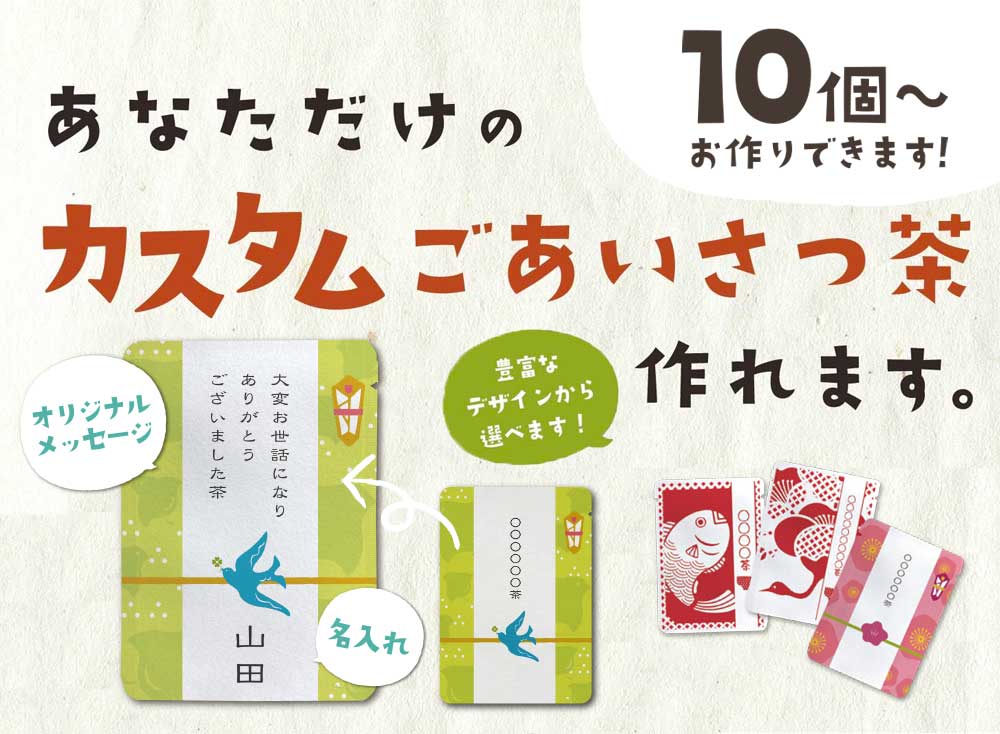
A special tea packed with heartfelt sentiment. A one-of-a-kind tea with an original design from Gozaisatsucha. Custom order available.
We can also handle large orders of 3000 units or more!


What is the most commonly used business card in Japan, the No. 4 business card?
The most widely used business card size in Japan is the "No. 4 business card." When you see "standard size" or "regular size" when ordering new business cards, it almost always refers to this No. 4 size.
Actually, there's a little interesting trivia about this size. Even though they're the same 55 x 91 mm business cards, in the Kansai region, especially around Osaka, they're sometimes called "No. 9 business cards." This is said to be because there were differences in the names used for paper sizes between Tokyo and Osaka.
Although they are called by different names, their size is exactly the same. Even the business cards we use casually every day have hidden traces of this history and culture.
The secret behind the history of how business cards came to be this size.
Actually, the size of the business cards we use every day has a very interesting history.
The history of Japanese business cards began in the Edo period.
It is said that the use of something like a business card in Japan dates back to the Edo period. At that time, business cards were not used for greetings with people you meet for the first time as they are today. It was customary to leave a piece of paper with your name on it to let the person you visited know that you had come, if they were not home, and this is considered the origin of business cards.
This piece of paper was called an "okigoma" and was long and narrow, measuring approximately 15 centimeters vertically and 5 centimeters horizontally. It seems quite large compared to modern business cards, but at the time, it was common to write names with a brush and ink, so a size that was easy to write on was necessary.
Later, during the late Edo period, business cards printed with names using woodblock printing appeared and began to be used among diplomats and government officials. They gradually evolved into a form similar to modern business cards, but at that time there were no fixed size standards. The size of business cards that is commonplace today has also been gradually shaped over a long history.
The reason is related to old Japanese units of length.
The 55 x 91 mm business card size widely used in Japan today is related to the units of length that were used in Japan in the past.
In old Japan, units like "sun" and "bu" were used to express length. Based on these units, the longer one is "3 sun (approximately 91 mm)" and the shorter one is "1 sun 8 bu (approximately 55 mm)," with a balance that makes them easy to carry and easy to read.
Subsequently, this size spread throughout Japan from the Taisho era to the post-war period and became widely used. Then, in 1949, it was officially established as a standard size and became the standard size we have today.
The business cards we take for granted are actually the result of inherited units of measurement and the wisdom of people from the past. Knowing the reasons why they have been loved for so long might make your usual business card feel a little more special.
The deep connection between business card size and the golden ratio
Have you ever picked up a business card and felt that it was somehow "clean and easy to read" or "well-formed"? The truth is, there's a ratio to business card size that humans instinctively perceive as beautiful. Here, we'll unravel the secrets of business card design and beauty.
The golden ratio is what people perceive as beautiful.
The golden ratio is the ratio that humans perceive as most visually stable and beautiful. This ratio is said to be "1:1.618".
This ratio can be found in nature, such as the arrangement of plant leaves and the spiral of seashells. It has also been incorporated into historical works of art and architecture, such as the Parthenon in ancient Greece and Leonardo da Vinci's "Mona Lisa." Even today, it is used in many everyday things, such as smartphone designs, credit cards, and website layouts. Even without realizing it, this golden ratio is hidden in many things that we perceive as having "good balance."
The aspect ratio of a business card is very close to the golden ratio.
The most commonly used business card size in Japan is 55mm x 91mm. When calculated in terms of ratio, this comes out to 1:1.654.
When compared to the golden ratio of "1:1.618," the numbers are surprisingly close. Let's compare the ratio of a business card with the golden ratio side by side.
| kinds | aspect ratio | Ratio values (approximate) |
|---|---|---|
| Golden Ratio | 1 : 1.618 | 1 : 1.62 |
| Japanese business card (55mm x 91mm) | 1 : 1.654 | 1 : 1.65 |
As you can see, the size of a business card is very close to the golden ratio, so even though it's small, the information is neatly arranged and easy to read. The reason business cards are this size may be not only for portability but also for aesthetic appeal.
summary
Business cards are used almost every day, but their size is steeped in history and ingenuity, incorporating elements such as old Japanese units of length and proportions that people find aesthetically pleasing. Even the size, which we rarely think about, has a long history behind its established form. Learning a little about business cards might give you a different perspective on your usual business card exchanges. Please use this information as a reference when creating or choosing your next business cards.