Hello! This is Goencha ^^ Today, I'd like to introduce the origin of the name "business card." Business cards are used as a matter of course in the business world, but have you ever wondered, "Why is the kanji character for 'piercing' used?"
In fact, its origin is said to be the ancient Chinese custom of placing a wooden or bamboo tag with one's name written on it at the doorway of the place one is visiting. This time, we will explain in an easy-to-understand way everything from the meaning of the kanji characters for "business card" to the changes in its history in Japan and around the world, and the basic business card exchange etiquette you should know. Knowing the roots of business cards may give you a slightly different perspective on your usual business card exchanges.


Table of Contents
The origin of business cards and the secret hidden in the kanji character “刺” (shi).
We exchange business cards casually every day. But have you ever wondered, "Why is it written as '名刺' (meishi) and not '名紙' (meishi) when it's just a piece of paper with a name on it?" The truth is, this single character, "刺" (shi), holds the long history of business cards and the wisdom of people from the past. Let's begin by unraveling the secrets of this kanji character.
Why is the kanji character “刺” (tsuke) used in business cards?
The word "meishi" (business card), which we use every day without thinking, contains the kanji character "刺" (shi), which has a deep meaning related to engraving characters or inserting something.
It began with sticking wooden or bamboo tags into doorways.
In ancient China, paper was still very precious, so thin planks of wood or bamboo (wooden or bamboo tags) were used as a substitute. When visiting someone's house, if the host was not home, one would write their name on the wooden tag and "stick" it into the gap in the doorway or into a mailbox. This act of "sticking a tag with one's name on it" is said to be the origin of the kanji character "刺" (sa), meaning "to pierce" or "to carve" characters into bamboo or wooden tags. Another theory suggests that the character came to be used because of the act of "piercing" (carving or carving) characters into bamboo or wooden tags.
The origin and history of business cards in Japan
The business card culture, which originated in China, later spread to Japan, gradually changing its form over time. Business cards, now commonplace, apparently had a different role in the past. Let's trace the history of how business cards began and how they have become so popular in Japan.
In the Edo period, washi paper was used to indicate absence.
It is said that business cards began to be used in Japan during the Edo period in the 19th century. At that time, if someone was away when they visited, people would write their name in ink on handmade Japanese paper and leave it there. This is said to be the beginning of business cards in Japan. At that time, printing technology was not yet widely available, so each business card was handwritten. Later, towards the end of the Edo period, woodblock printed business cards appeared and began to be used among officials who interacted with foreign envoys. Some even featured family crests, and it is said that business cards gradually evolved into the form they are today.
It became widespread as a social tool during the Meiji era.
With the arrival of the Meiji era, Western culture was introduced to Japan in great numbers. Along with this, printing technology advanced, and business cards became an indispensable tool in social gatherings of the upper class. Especially during the Rokumeikan era, exchanging business cards became a crucial manner for indicating one's status and title. From this time onward, business cards began to play an important role in building trust in business and social interactions, leading to their modern form.
Make business card exchanges more enjoyable! Tea gifts from “Kyoto Gyokuro Goen Tea”
What is Kyoto Gyokuro’s Goen Tea?
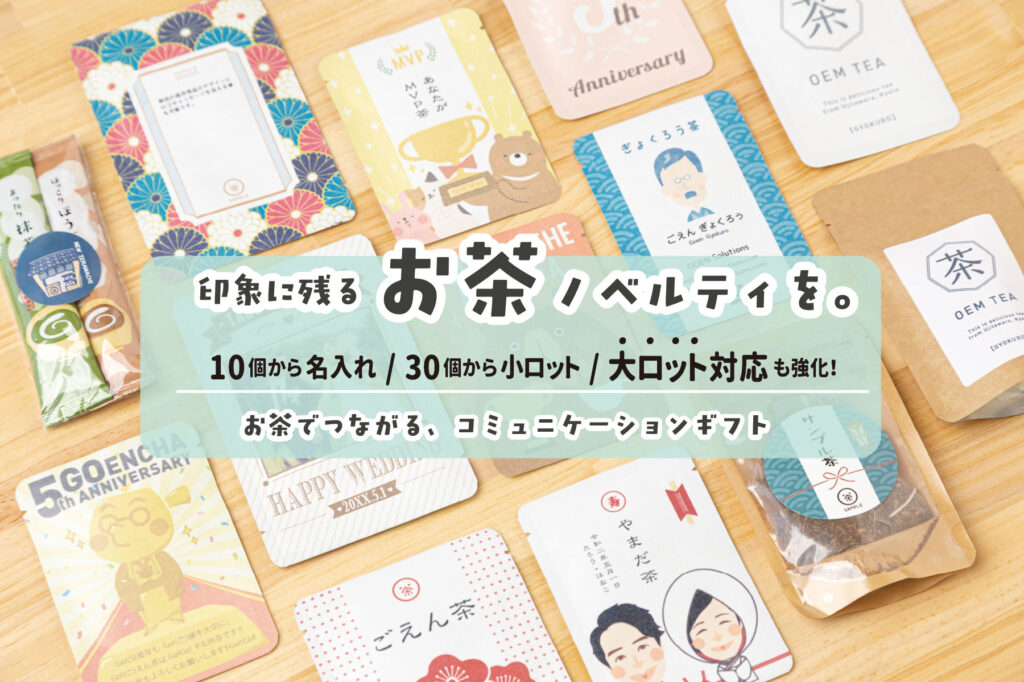
" Kyoto Gyokuro no Goencha " is a tea shop that delivers tea from Kyoto with the concept of "making tea more enjoyable." We strive to make high-quality tea more accessible and familiar to people, tailoring our offerings to meet their needs.
We cherish the idea of "tea that connects people," and we offer a wide variety of products perfect for your daily tea time, as well as gifts for special people and various promotional items. Our products, especially those with original designs and personalized engraving, are highly recommended as gifts !
Why not convey your feelings of "Nice to meet you!" and "I look forward to working with you in the future!" by pouring them into a cup of tea?
Here are some recommended gifts that convey your message!
A special tea packed with heartfelt sentiment. A one-of-a-kind tea with an original design from Gozaisatsucha. Custom order available.
We can also handle large orders of 3000 units or more!


Differences in the origins and usage of business cards around the world
The culture of business cards has developed uniquely not only in Japan but also around the world. In Europe and America, they have their own distinct histories and roles, somewhat different from those in Japan. This article will introduce how business cards originated and have been used in each of these countries.
The origins of business cards in Europe
The history of business cards in Europe dates back to around the 16th century. At that time, they began to be used as message cards to let people know that you had visited their home if they were not home. This is the origin of what is called a "visiting card."
Later, during the opulent era of dynastic culture in the 17th and 18th centuries, cards became widespread as an important tool for greeting in the social circles of the nobility. Beautifully engraved cards and lavishly decorated cards were created, and they also served to indicate one's status.
In modern Europe, not all business people frequently exchange business cards. It's mainly used by a limited number of people, such as company managers and executives, as a form of greeting at social gatherings like parties.
The role of business cards in America
The history of business cards in America dates back to the latter half of the 19th century. At that time, wealthy Americans used them as status cards to indicate their social standing and status.
In the 20th century, business cards increasingly took on the role of "business cards" used in business settings. In modern America, business cards are no longer simply for sharing names and contact information. They are often used as promotional tools to showcase oneself, one's company, or one's products.
In the American business world, it's uncommon to exchange business cards immediately upon meeting someone for the first time. Instead, it's more common to first shake hands, introduce oneself, and enjoy a conversation. Then, contact information is only exchanged at the end with someone you wish to stay in touch with.
| Country/Region | Historical beginning | Main uses in modern times |
|---|---|---|
| Europe | Cards used to announce absence in the 16th century, and greeting cards used in high society. | It is mainly used by managers and executives in social settings and parties. |
| America | Status cards of the late 19th century | A tool for promoting yourself or your company, and a way to share future contact information. |
Business etiquette for exchanging business cards

Business cards are an important tool for connecting you with others. To ensure a pleasant exchange of greetings, let's learn some basic etiquette. This article explains key points for conveying respect to others.
Basics of giving and receiving business cards
When exchanging business cards, the basics are to make eye contact with the other person and greet them with a smile. There are also important rules for the actions of giving and receiving business cards, as follows:
| scene | Important points | Tips for operation |
|---|---|---|
| When handing out business cards | Turn it so that it is facing you from the other person's perspective. | Take your business card from your card holder, hold it with both hands, and present it to the other person so they can read the text. At that time, clearly and cheerfully state your company name, department name, and your own name. |
| When receiving a business card | Avoid touching the other person's fingers or the writing on their business card. | Say "Thank you very much" and receive the card politely with both hands. After receiving it, do not immediately put it in your business card holder, but rather place it neatly on the table; this is considered good manners. |
The general rule for exchanging business cards is that the visitor should offer their card first. If there are multiple people, exchange cards in order of rank, starting with the person with the highest position. Place the received business card on top of your business card holder on the table to your left. If there are multiple people, arranging the cards according to their seating arrangement will help ensure smooth conversation and prevent you from mixing up names.
Make sure to remember each other's faces and names, and take the first step towards building a good relationship by carefully exchanging business cards.
summary
The use of the kanji character "刺" (shi) in "名刺" (meishi) originates from the Chinese practice of leaving a wooden or bamboo tag on the doorway when someone was away. In Japan, it began as a way to notify others of someone's absence during the Edo period, and today it is used as an important business greeting tool. A business card is not just a piece of paper; it is a tangible expression of respect for the recipient and a way to create new connections. Let's cherish good manners and cultivate pleasant encounters for each other.